No sooner had the white stork (Ciconia ciconia) become extinct in Switzerland in 1949, than an attempt was made to reintroduce it. Around the same time, one of the less well-known Dennis creations, the Dennis Stork came onto the market. The Stork was announced in The Commercial Motor on September 12th 1952 concurrently with the Lancet UF. Both were of the newfangled underfloor engine configuration. The Lancet was a standard 30ft by 8ft single deck bus chassis, weighing in at around four tons, continuing the Lancet name and hoping to be as successful as its predecessors, of which around 2000 were built between 1930 and 1950. The Stork was something completely different. The idea was to produce a three ton chassis suitable for carrying a goods body, a parcel van or perhaps a mobile shop, using underfloor technology. In all around 70 underfloor Lancets were sold: East Kent took 30 coaches, and Glenton a further 10. Newport City Transport bought 12 with bus bodies and a further 7 buses were placed in service by Somerset independent Hutchings and Cornelius of South Petherton, a long time buyer of Dennis products. Cookes Coaches of Stoughton (Guildford) purchased two with coach and a further two with dual purpose bodywork. The rest were "one-offs", one even finding its way to Western Australia! It was only realised as an afterthought that the Stork chassis might be suitable for carrying a bus or coach body, a "midibus" - although the term did not come into use until the 1980s. As a bus the Stork was even less successful than the Lancet UF. 30 Stork SU20s were sold to London County Council, apparently as school buses. Three batches of 10 vehicles with Dennis's own B31C bodywork were supplied in 1956 (SJJ821-830) and 1957 (TLP771-780 and ULE806-815). A further 6 examples - 4 SU12s and 4 SU16s - were acquired singly by Walthamstow Borough Council between 1956 and 1960. These had B30F bodywork by Denver (1) and Sully, Blackford & Hawkey (5), in one of two models: SU12 and SU16. Trawling the The Commercial Motor Archives for articles about the Dennis Stork I came up with no fewer than 38 hits, of which around 30 are relevant. Filtering the information included in these articles paints a different picture of this unique vehicle. It would seem that in all, a total of around 70 parcel-vans were sold.
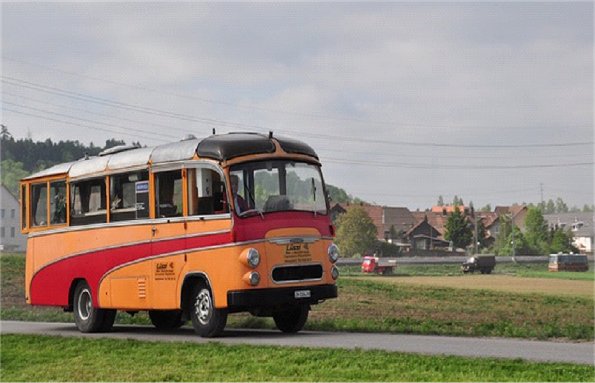
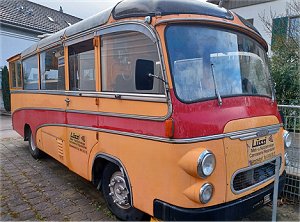
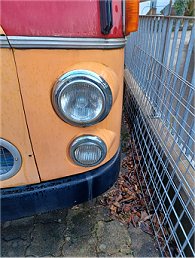
And now comes this unexpected news from another quarter. Research by Urs Strub of IGBus, a Swiss bus enthusiast group, has uncovered 8 orders for a total of 11 Dennis Stork chassis delivered to dealer Helios AG in Zurich. They all sported coach bodywork supplied by local bodybuilders: Frech-Hoch, Sissach (6); Gangloff, Berne (3); Krapf, Amriswil and Ramser & Jenzer, Berne (1 each) in accordance with the wishes of their individual. One example delivered to the Gruyère-Fribourg-Morat Railway in 1956 bore chassis number 109SU18, a type hitherto unknown to me. Coaches in Switzerland were mostly right-hand driven up until the mid-1960s and so it is unlikely that the designation SU18 indicated a LHD version designed for the foreign market. It is virtually certain, that the Swiss Storks, like their UK counterparts, were RHD too. 6 cylinder Perkins engines also appear to have been standard. Sifting through the Dennis Society archives, Gerry Blixley has come across five export orders from Switzerland for nine SU18s (wheelbase 11' 4¼" – 3460mm), together with an order for 2 SU17s (11' 8" – 3556mm) and 2 orders for single S20s (12' 6¼" – 3816mm). So it would seem that at least 15 Storks were exported to Switzerland. The data from the two sources now has to be collated and, if possible, complemented - no easy task! At least one Swiss Stork is known to have survived. Dennis Society member, Fredi Räber, captured this, clearly RHD, Stork on film during a cavalcade of vintage vehicles in 2018. This Stork, chassis number 105SU18 was bodied by Frech-Hoch and originally had around 18 seats. It entered service with operator Konrad Leu of Schaffhausen on 16th July 1955 where it stayed until 17th January 1969. Sold on by a dealer to the Lüssi Family in 1976, it was rebuilt by them as a motor home with bay windows at the rear! Its engine (Perkins 65 hp 6 cylinder, No. 317 81 05 EXX 150) has a 5-speed ZF manual gearbox with a splitter-box resulting in a total of 10 gears. Thanks to a turbocharger it had a top speed of around 100km (60 miles) per hour. During its time as a motor home, the Lüssi family travelled far and wide throughout south-western Europe and they even took it across the Grossglockner Pass (2'400 m/8000 ft a msl) in Austria without any major problems. The coach, still in the guise of a motor home, is in Alfred Lüssi's possession as these photos taken in February 2026 prove. To my amateur eyes, it seems to be in remarkably good condition. The rear dome was scrapped many years ago. Although no longer taxed and licenced, it is still moved occasionally on trade plates (Mr Lüssi is a garage owner), whilst awaiting a decision on its ultimate fate…
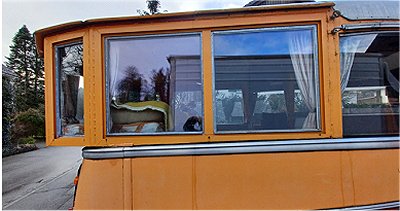 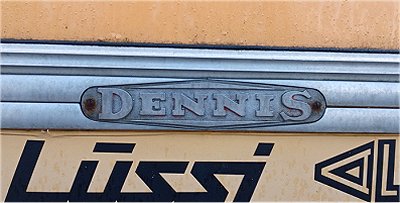 Peter Phillips (text and photos) acknowledges and thanks Fredi Räber (photo), Urs Strub, Gerry Blixley, Alfred Lüssi and, last but not least, Bus Lists on the Web (BLOTW) for additional data.
|


 Newsletters
Index
Newsletters
Index